

Lately, there's one question I ask on almost every call with an owner who wants to talk about a new property. I ask it a little nervously, and I've caught myself holding my breath while I wait for the answer.
"How is it heated?"
Here's why I'm nervous. If the answer is oil, the rental value of that property is falling as we speak, and most rental property owners don't realize.
Heating season just showed up on everyone's radar
Right now people are doing what they do every fall. They're scheduling furnace cleanings, digging out winter coats, and calling to get the oil tank filled. And they're getting sticker shock.
So let me put a pin in today. On September 28, 2026, the average price of heating oil in Pennsylvania is about $5.65 a gallon. Suppliers are quoting anywhere from $5.45 to $6.00, and prices are up about 20% in just the last six weeks.
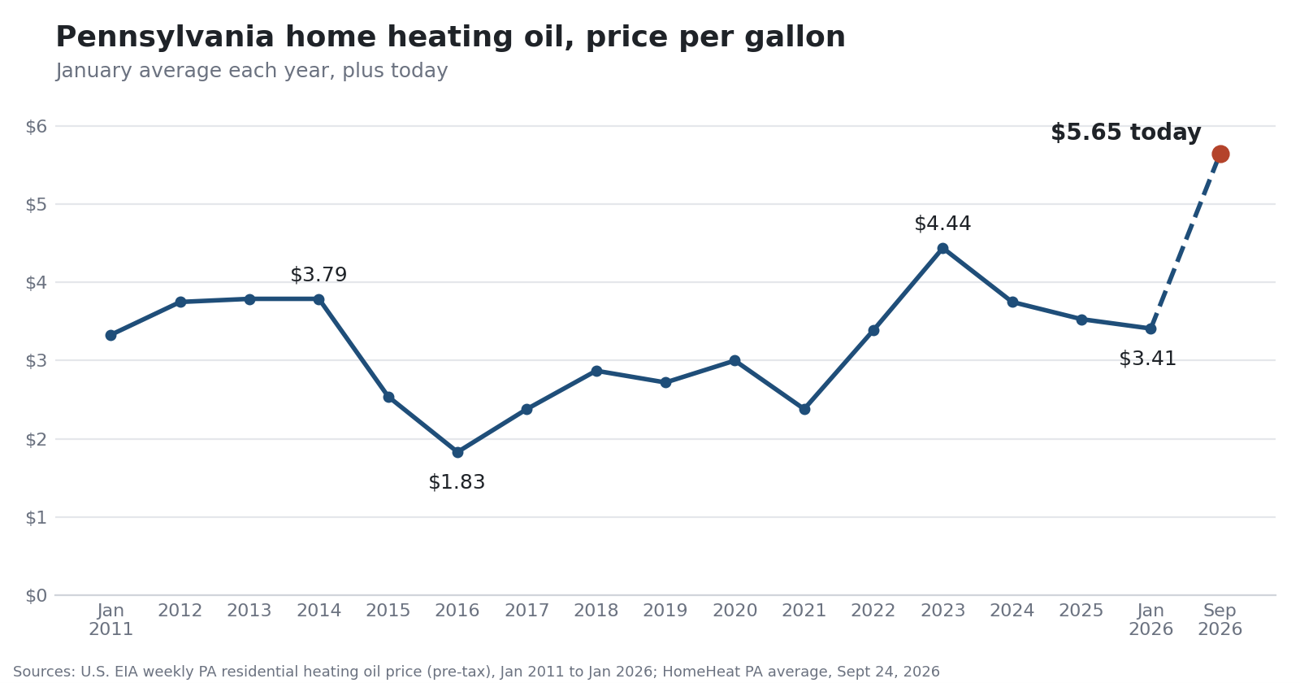
Here's the last 15 years. Oil ran around $3.75 a gallon in the early 2010s, crashed under $2 by 2016, and spent most of the next several years between $2 and $3.50. Last January it was $3.41. Today it's $5.65. That's about two thirds higher than last winter, and it's not the first spike. Oil jumped in 2022 too. It keeps happening, and every time it does, owners with oil heat get caught.
What that does to a rental
When tenants perceive the costs of heating to be high, you see it in the performance of the property:
- Renters move on. People shopping for a place start asking how it's heated. When they hear "oil," they go to the next listing.
- Rents come down. The oil units that do rent, rent for less, because qualified renters do the math on rent plus heat.
- Current tenants fall behind. When heat costs as much as a second rent payment, something doesn't get paid.
- Owners who pay the heat eat the bill. All winter long and nobody sends a thank you.
That's what I mean by value falling. Rent is what someone will pay to live there, and nobody wants to pay full rent on a unit that costs a fortune to keep warm.
Let's do the math
The price per gallon or per kilowatt hour doesn't tell you much on its own. What matters is how much it costs to get the same amount of heat into the house. Heat is measured in BTUs, so here's roughly what one million BTUs of heat costs right now in our area. These numbers include the utility delivery charges and how much of the fuel each system actually turns into heat.
| Heating type | How much of the fuel becomes heat | Cost per million BTUs of heat |
|---|---|---|
| Oil furnace or boiler | About 80% | About $51 |
| Electric baseboard | 100% | About $53 |
| Natural gas furnace | 80% to 95% | About $17.50 to $21 |
| Heat pump | 250% to 300% | About $18 to $21 |
Yes, a heat pump beats 100%. It doesn't burn anything. It pulls heat out of the outside air and moves it inside, so you get two to three times more heat out of every dollar of electricity. Baseboard turns every bit of electricity into heat, but electricity is expensive, so it still loses.
Now let's make that real. Picture a regular-size apartment that burns about 540 gallons of oil over a winter. Here's roughly what the same amount of heat costs with each option:
- Oil: about $3,050 for the winter
- Electric baseboard: about $3,150
- Natural gas: about $1,050 to $1,250
- Heat pump: about $1,050 to $1,250
Spread over five cold months, that's around $600 a month on oil and around $230 a month on gas. Your building, your insulation, and the winter we get will change the numbers, but they won't close that gap. Gas rates are expected to go up a little this winter too, and it's still not close.
"But PM Jen, electric baseboard is expensive too"
It is. Electric baseboard heat has always been about as painful as oil, and the math above proves it. But electric baseboard properties have a few safety nets that oil tenants don't:
- The electric companies have assistance programs for customers who are struggling.
- Budget billing spreads the cost out so one cold January doesn't wreck anyone.
- The electric company has rules it has to follow before it can shut someone off, especially in the winter.
Oil doesn't work like that. The oil company has to drive a truck to your house, and if you can't pay, a lot of them won't come. Many want payment up front, and many have a minimum order. So when a tenant runs short on cash, the tank runs dry, and now you've got a no heat call, a frozen pipe risk, and a tenant who's scared and cold.
How I rank heating for a rental
Cost is only part of it. When I look at a rental, I'm also thinking about who pays, how reliable it is, and what tenants want. Here's my ranking, best to worst:
- Natural gas, one boiler/furnace per unit, tenant pays. Cheapest heat, tenants understand it, and the bill goes in their name.
- Heat pump. Close to gas on cost, and you get air conditioning built in. This is the answer when there's no gas on your street. Buy a cold climate model, because regular heat pumps struggle on our coldest days.
- Electric baseboard. Expensive to run, but cheap to maintain, easy to meter separately, and tenants get the utility safety nets above.
- Oil. Expensive, delivered by truck, paid up front, and prices are volatile. It's the most likely to leave you with a vacancy, a no heat call, or a big bill of your own.
My own oil story
This isn't just something I tell clients. About a year ago, I bought a two-unit property with one oil boiler. Because there was only one boiler for both units, I paid for the oil. That bill was about $5,000 a year, and that was when oil was around $3 a gallon.
I didn't wait. I replaced that boiler with two natural gas furnaces with central air, one for each unit, and I rewrote the leases so each tenant pays their own gas.
Here's what I dodged. That $5,000 bought about 1,670 gallons of oil. The same amount of oil at today's price would cost over $9,000 a year, straight out of my pocket. Man, do I feel smart now.
I'm also really glad I did it on my schedule and not the boiler's. If I'd waited for it to get red tagged, I'd have been making a big decision in a hurry, probably in January, with two units of tenants and no heat.
I've seen this before, and I'm ready for it again
When oil prices spiked in the twenty-teens, I was converting oil properties to natural gas and electric heat pumps all the time. For the last several years, that pretty much stopped. I expect it to pick right back up this winter.
If you own an oil heated rental, here's what to think about:
- Is gas on your street? If yes, converting to gas can be the best long-term fix.
- No gas? A lot of North Central PA doesn't have it. A cold climate heat pump is usually the next best option, and it adds air conditioning too.
- Can each unit pay its own heat? Separate systems and separate meters take heat off your expense line while occupied.
- Don't wait for the red tag. Plan it now so you're doing this on your timetable, and not in reaction to an emergency when it will definitely cost you more.
Your property manager should be thinking about this for you
Here's my honest take. You should have a property manager who's watching fuel prices, thinking about what they do to your rents and your vacancy, and telling you before it hurts.
And for goodness sakes, when your oil boiler gets red tagged, your property manager should at least talk to you about switching fuels. Not just swap in another oil boiler and send you the bill. A heating replacement is one of the best chances you'll get to raise the value of your property and the income it earns.
That's how we manage at One Focus Property Management. We think a season ahead so you're not the one caught off guard.
If you own a rental and you're not sure how it's heated, or you know it's oil and now you're nervous too, let's talk.